












Nepal Attractions & Experiences: An Expert Guide
Few countries compress as much into so small a space as Nepal. Within a day’s drive you can move from the medieval temple squares of the Kathmandu Valley to subtropical jungle thick with rhino and tiger, and within a few hours’ flight from the valley floor to the base of the highest mountain on Earth. At Earth Trip, our Nepal specialists have travelled the country extensively, and we build every itinerary around genuine first-hand knowledge of what’s actually worth your time, not a generic checklist.
This guide covers the attractions and experiences we draw on most often when designing a private, tailor-made Nepal holiday. Read more about Nepal, including entry requirements and the best time to travel, or jump straight to our Classic Nepal Holiday itinerary to see how these pieces fit together.
The Kathmandu Valley: Living Heritage
Kathmandu itself is often treated as a stopover, somewhere to land before heading to the mountains. We think that’s a mistake. The valley holds seven UNESCO World Heritage Sites within a roughly 15-kilometre radius, more concentrated historic architecture than almost anywhere else in Asia.
Kathmandu Durbar Square, the former royal palace complex, is the obvious starting point, its carved wooden temples and courtyards built up over five centuries by the Malla kings. A short walk away, Swayambhunath Stupa, known locally and to visitors as the Monkey Temple, crowns a forested hill with sweeping views across the city, while Boudhanath Stupa, one of the largest spherical stupas in the world, sits at the centre of Kathmandu’s Tibetan Buddhist community, best visited at dusk when pilgrims circle the mandala by candlelight. Pashupatinath Temple, on the banks of the Bagmati River, is one of the most important Hindu sites in the world, and visitors can respectfully witness cremation rituals that have continued unchanged for generations.
Beyond the capital, Bhaktapur and Patan Durbar Square reward a slower pace. Bhaktapur in particular has largely escaped the traffic and development that’s changed Kathmandu, its potters’ square and pagoda-roofed temples feel genuinely lived-in rather than preserved for visitors. Patan’s Durbar Square is, in our view, the most architecturally refined of the three, and its museum holds an exceptional collection of bronze religious art.
Into the Himalayas: Trekking Nepal
Trekking is what draws many travellers to Nepal in the first place, and the range of options means there’s a route for almost any level of fitness and time available. The Everest Base Camp Trek is the best known, a multi-day route through Sherpa villages and Sagarmatha National Park, ending at the foot of the world’s highest mountain. The Annapurna Circuit is its equal in reputation, a longer route circling the Annapurna massif through a remarkable range of landscapes and cultures.
For travellers with less time, or who simply want a taste of the Himalayas without committing to a multi-week trek, Poon Hill delivers one of the best sunrise panoramas in the country in a fraction of the time, Annapurna South, Machapuchare and Dhaulagiri all visible from a single summit. Further north, the Langtang Valley offers a quieter alternative close to the Tibetan border, with fewer crowds and a strong Tamang cultural identity. For those who want the view without the walk, a mountain flight to Everest from Kathmandu gives close-up views of the eastern Himalayas in under an hour.
Pokhara & the Lake Region
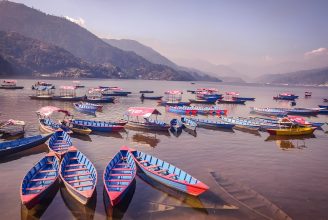
Pokhara is Nepal’s adventure capital, and for good reason. Set against the Annapurna Range and built around Phewa Lake, it’s both a relaxed base for boating and lakeside dining and a launchpad for the Annapurna treks. It’s also where we’d send anyone after an adrenaline hit: paragliding from Sarangkot is one of the most spectacular tandem flights anywhere in the world, soaring above the lake with the Annapurna Range as a backdrop.
Wildlife & Rivers: Chitwan and Beyond
Chitwan National Park is where Nepal’s lowland Terai region comes into its own. This UNESCO-listed reserve is one of the last strongholds of the one-horned rhinoceros, and also shelters Bengal tigers, though sightings of the latter are rare. We explore it by jeep safari, dugout canoe and guided walk with local naturalist guides, a genuinely different side of Nepal from the mountains most visitors picture.
For something more active, Nepal’s rivers offer some of the best white-water rafting in Asia. The Trishuli is accessible and family-friendly, while the Bhote Koshi offers more serious rapids for experienced rafters.
Off the Main Routes
Nagarkot, a short drive from Kathmandu, is the easiest way to see Himalayan sunrise and sunset views without leaving the valley. Bandipur, a beautifully preserved Newari hill town largely bypassed by modern development, is one of our favourite lesser-known stops, cobbled streets and traditional architecture with none of the crowds. And Lumbini, in the country’s south, is the birthplace of Siddhartha Gautama, the Buddha, a place of real pilgrimage significance with monasteries built by Buddhist communities from across the world.
Planning Your Nepal Journey
Every Earth Trip itinerary is private and tailor-made, built around how much time you have and what you actually want from the trip, whether that’s a serious trek, a gentler cultural introduction, or a combination of both. See our approach to responsible travel, read what past clients say on Trustpilot, or browse our full Nepal holiday collection.
Frequently Asked Questions
What is the best time to visit Nepal?
October to November and March to April offer the clearest mountain views and most comfortable trekking conditions. December to February is colder but still good for lower-altitude sightseeing in Kathmandu and Chitwan.
Do I need to be an experienced trekker to visit Nepal?
No. Shorter routes like Poon Hill are accessible to most reasonably fit travellers, and Kathmandu, Pokhara and Chitwan can all be enjoyed without any trekking at all.
How many days should I spend in Nepal?
10 to 14 days allows time for the Kathmandu Valley’s temples, Pokhara and a short trek or wildlife safari in Chitwan. Longer treks like Everest Base Camp or the Annapurna Circuit need 2 to 3 weeks on their own.
Is Chitwan National Park worth visiting if I’m not doing any trekking?
Yes. Chitwan offers a completely different side of Nepal, lowland jungle, rhino and tiger habitat, and is a strong addition to any itinerary focused on the Kathmandu Valley and Pokhara.
Can I combine Nepal with India or Bhutan?
Yes, Nepal pairs naturally with both. Ask our team about combined South Asia itineraries.
Ready to start planning? Contact our Nepal specialists today.

Speak to our Nepal travel expert today
Aleem Raheem, Co-Founder and Sustainable Travel Expert | Earth Trip
Speak to our Nepal travel expert today
Aleem Raheem, Co-Founder and Sustainable Travel Expert | Earth Trip
Tailor-Made Luxury Tours with a Private Driver
Earth Trip designs exclusive, bespoke tours featuring private drivers and hand-picked luxury accommodations, built entirely around your personal preferences and travel style.
Bespoke Holidays
 Nepal Attractions